Trust Your Own Counsel for Real Work–Life Harmony
May 29, 2026I never did fall for the myth of work-life balance, but I did believe that work–life harmony could be achieved by implementing systems, routines, and boundaries. I was convinced that the key was finding the right system: the perfect calendar, the ideal morning routine, the flawless script for saying no. But the endless hunt for the latest tips and tricks from productivity gurus became exhausting in itself.
The more I work with women approaching or well into their encore years, and the more I watch my own patterns, the more I see that lasting harmony starts somewhere much quieter:
“I already know what’s true for me. I’m not looking for answers from others.”
Day 56 of The Pivot Year lands exactly there. It’s an invitation to stop acting like we’re lost when, deep down, we usually aren’t. We might be afraid, conflicted, or unsure how others will react—but on a soul level, we already know.
The moment I realized I was over‑asking
There have been times in my life when I sought external reassurance before making changes to my work or schedule:
-
“Do you think I should cut back on client hours?”
-
“Is it unreasonable to say no to that committee?”
-
“What would you do in my situation?”
On the surface, it looked like “being thoughtful.” Underneath, it was a way of avoiding my own knowing.
Because if I slowed down long enough to listen to my inner voice, the truth was simple and uncomfortable:
-
I was tired and overextended.
-
I felt exploited and undervalued.
-
I wanted more space for my health, my interests, friendships, and nothing‑in‑particular time.
No one else needed to tell me I was at capacity or validate that "yes", I was being exploited. My body was telling me. My irritability was telling me. My quiet resentment was telling me.
The real work wasn’t seeking or finding the answer. It was trusting it.
From role to soul: whose voice gets the final say?
For decades, many of us have been rewarded for listening outward first: to bosses, clients, family, and cultural expectations. That’s how we learned to be “good” leaders and reliable women.
In our encore life, that hierarchy has to flip.
-
Role says: “Keep being who you’ve always been for others.”
-
Soul asks: “Who are you now, and what actually fits this season of your life?”
Trusting my own counsel looks like this: I let the soul voice have the final say about my time, energy, and boundaries; even if the role voice protests - and it will!
My inner voice might sound like this:
-
“I know they’d like me to stay on that board, but I can feel I’m done.”
-
"While the world urges me to either 'stay busy' or 'retreat in retirement,' my soul yearns for a slower pace—for the time and space to explore my creativity and other interests."
-
“On paper, I can squeeze this in. In reality, my nervous system is saying no.”
No book or celebrity guru can answer those questions better than my own inner voice. The role of a book, a guru, or my mentors and coaches isn't to overrule what I know, but to help me hear my own voice with greater clarity.
A longer life needs inner leadership
In a long, multi‑stage life, there isn’t one “correct” script for your encore life. The world is changing; our bodies and circumstances are changing. That’s why inner leadership—trusting your own counsel—is so critical.
When I trust my knowing, my wisdom:
-
I choose work that fits my current energy, not the energy I wish I still had.
-
I let go of obligations that once made sense but now keep me stuck in an older chapter.
-
I give myself permission to be a beginner again—at the piano, on my e-bike, in creative projects, in rest—without asking if it’s “normal” for my age.
That doesn’t mean that I never listen to others or appreciate their input. It means I treat their input as information, not instruction. I’m the only one who lives inside my life full‑time. Ultimately, I’m the one who has to carry the consequences of my yes and my no.
Boundaries that come from the inside out
When you stop looking outward for every answer, boundaries stop being abstract "communication skills" and become simple extensions of what you know is true, an affirmation of healthy self-regard, and a testament to your "emotional intelligence skills".
Inside, you know:
-
“I don’t have the bandwidth for this.”
-
“This relationship drains me more than it feeds me.”
-
“I’m better when I have unstructured mornings.”
-
“I feel most alive when I protect time for music, movement, reading, writing, or nature.”
From there, a boundary becomes:
-
“I’m not available for early morning and evening meetings anymore.”
-
“I can help with this, but not every week.”
-
“My Sundays are non-negotiable.”
-
“I keep the promises I make to myself; I do not negotiate with myself.”
You may still feel wobbly saying it. You may still hear the old voice whisper, “Is this selfish?” But the more you act on your own counsel, the more your nervous system learns: it is safe to honour what I know. I trust in my ability to do well and make the best decisions for myself.
A simple practice: consult yourself first
This week, try a tiny experiment in trusting your own counsel:
-
Consider a decision about your work, time, or relationships that you've been hesitant to make.
-
Before you ask anyone for input, sit quietly and ask:
-
“If I were completely honest, what do I already know is true for me here?”
-
-
Write down the first clear sentence that comes.
-
Let that sentence shape one small, concrete action or boundary.
You can still talk it through with others if you choose, but speak from the stance of someone who already knows her truth and is discerning how to live it, not someone waiting to be told who she should be or what she should do.
Work‑life harmony in your encore years won’t come from finally finding the perfect outside formula. It will come from acting a little more each day on what you have quietly known for a long time.
You already know what’s true. The next chapter begins when you start believing in yourself and your capabilities. That is "self-trust".
Are you ready? What's next?
If you were to take one intentional “pivot action” this week—one choice that honours who you are now, rather than who you’ve always had to be—what would you choose?
For many women, the most graceful first step is to subscribe to the Encore Newsletter, where I share curated reflections, resources, and practices for designing a refined encore life with discernment and ease.
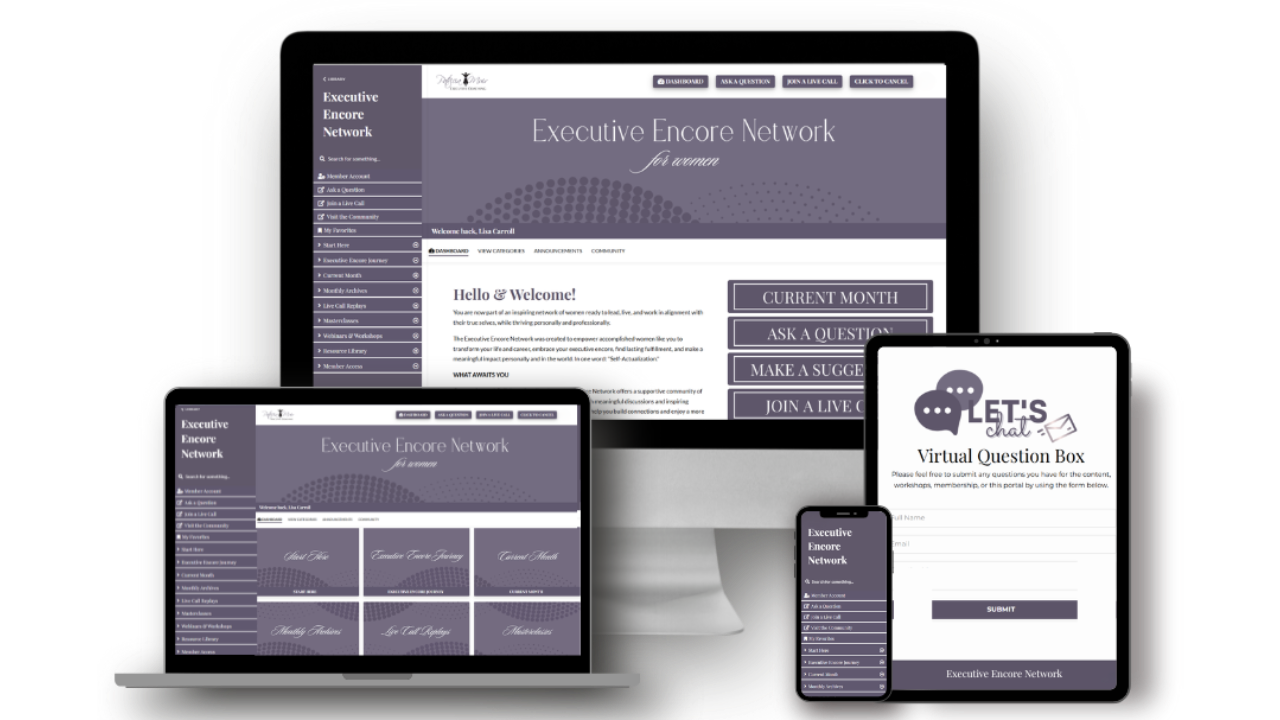
From there, the natural progression is the Executive Encore Network for Women—an intimate community for women who are no longer building their first career, but their most intentional chapter yet. Inside the membership, you’ll find invitations to group coaching sessions and the Encore Book Club, resources, and exclusive reflections from my journey through The Pivot Year, along with thoughtfully crafted tools to translate insight into elegant, sustainable change.
Twice a year, I invite a small circle of women who have stepped away from the work that once defined them to cross the next threshold together. If you sense that your next move deserves this level of intention and companionship, I invite you to join the waitlist for the next Encore Journey Circle by emailing [email protected] with the subject line: Encore Journey Circle Waitlist.
When you are ready, we’ll be here.
Next Steps
You don’t need to navigate your Executive Encore alone. Discover a better way to take charge of your experience.
- Schedule a 30-Minute Complimentary Executive Encore Call.
Ready to elevate your encore chapter?
- Join the Executive Encore Network for Women, a membership and community of supportive women ready to inspire and uplift.
- Subscribe to the Encore Newsletter to begin your Executive Encore Journey.